 Messed!Up
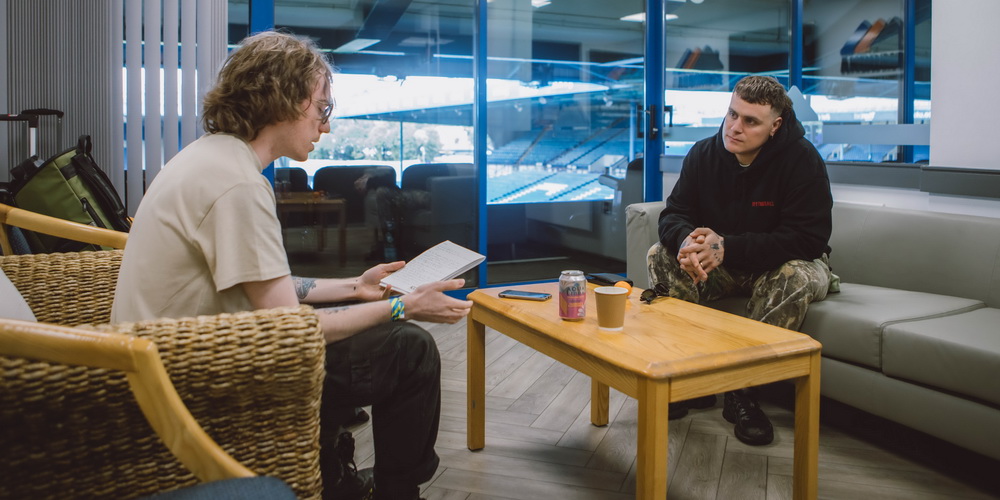
After a cramped and silent lift ride with a batch of other journalists up to Hillsborough Football Stadium’s VIP floor, Courtney and I arrived at a seating area akin to a hospital waiting room, where we awaited our allotted ten minutes with our allotted member of DMA’s. Around us, important looking people appeared out of doors labelled ‘The Enemy’, ‘Sea Girls’ and, of course, ‘DMAs’ – Tramlines Festival’s Friday headliners. To say I was nervous was an understatement. This was the real thing. No tiny green room shared by four bands; no aged table scraped across an alleyway smoking area. And yet, Johnny Took was wonderful.
As we were invited into the box, Johnny greeted us, shaking our hands, and I looked out onto the empty football ground below – lit up gold in a momentary gift of sunlight, and another reminder of how far away we were from the rain blanketing the main festival area.
DMA’s are an Australian indie-rock band, heavily influenced by giants of the typically British genre. Their fourth album, How Many Dreams, only elevates their popularity among UK audiences, but changes things up a bit. While the album features strong singles such as ‘Everybody’s Saying Thursday’s The Weekend’ in their typical style, the record features an expansion into the territory of electronic dance, with some of my favourite tracks being ‘Something We Are Overcoming‘ and closer ‘De Carle‘ that serve to put a different spin on DMA’s sound.
“Ten minutes,” said the attendant, and shut the door. And then all the bureaucracy fell away, and our encounter turned into three people discussing the art we love.
You bring a melancholy tone to your sound and lyrics that I think differentiates you from a lot of other artists in your sphere. Do you have a process that you approach lyric writing with?
“I think it’s maybe our influences. There’s obvious influences that people tie us to – The Stone Roses, Oasis, stuff like that – but I grew up listening to a lot of Bruce Springsteen, Joni Mitchell, and even bluegrass music. It’s funny, there’s a song I wrote called ‘Step Up The Morphine‘ which was about my grandmother, and that song (if you heard the original) almost sounds like a country song. But when Tommy sings it, he couldn’t sound country even if he tried. And so, I call it ‘happy-sad’ because sonically we like to make music that sounds quite anthemic, but at its core, even ‘Silver‘ was a folk song when it was originally written.”
You have quite a euphoric sound. Your lyrics are introspective and emotional, but then you bring these lifting choruses that I suppose create that anthemic sound. Have you found that the electronic elements of your more recent music have benefitted from that and offered you more options creatively?
“It’s definitely, for me, opened up a lot of gates because it’s a different way of songwriting in the sense that you can sit on a laptop and cut up samples, and play with synthesisers which is like unlimited amounts of sounds – there’s no rules.
When you’re writing with just a guitar – like, a G chord really sounds like a G chord, to me. Which is fine, but if you play a G chord on a pad you can’t really tell as much, which is what makes guitar so classic. But in saying that, a guitar is also limitless when you start learning different shapes and different styles. I guess we just have a thirst for knowledge when it comes to music and production, so I guess it was just the natural trajectory to start getting involved with more electronic elements.”
I find that, especially in guitar-based music, you get people who are against backing tracks, for example. With your genre and DMAs Brit-pop influences in mind, do you ever find that people push back against the electronic aspects?
“Oh, of course, yeah. Yeah, that happens. There’s also a thing where, like – say our first album, Hills End – [people] listen to that, and then maybe they start going out with their partner around that time, and they associate songs off that record and that sound with this really emotional part of their life. Music has that power, and you can really link it to memories and thought. My first dance song was ‘Swoon‘ by The Chemical Brothers, and now every time I hear that I’m like “Oh, my god!” People get attached to that.
You can look at it two ways; “That’s the sound I like!” People say that because, subconsciously, it reminds them of an emotional time of their life. But if the artist kept doing that sound, it wouldn’t be as special. People think they want to hear a band make the same record again and again and again, but the truth is, if that happened four albums in a row, people would get fucking bored, you know? And they’d stop listening to the band and go, “Oh, it just sounds like all their other shit.”
It’s really great to hear you say that, actually, because I hear that sentiment from a lot of people, saying, “This doesn’t sound like how they used to do it,” like that’s a bad thing. I don’t think change is necessarily a bad thing, is it?
“No! And also, there’s no right or wrong way to do music, and if a band wants to experiment with different things and try a different sound, then you can look at it a different way as well. I like it when a band I love changes their sound up a bit because it means I get to grow with the band, and I’m making new memories that I’ll associate with that new sound.”
Have you found that bringing electronic elements on board has made your live show more difficult? Are there any hurdles you have had to jump over because of that? Or has it been more exciting?
“It’s been more exciting for me. When you incorporate things like arpeggiators into the set, you have to build the live show around them – the live show needs to have the infrastructure to support that. It’s not the same as a guitar band just jumping up on stage and knocking it out.
So, we did that in steps. We got in-ear monitors first, and then the drummer can play to a click, so you can have some track come in and do the synthesised parts that are impossible to do live. But we are very conscious of our live sound. With the band that we have, we try and do as much as we possibly can live, because that’s what people love about live music.
I’ve seen a bunch of acts having more of their live sound on tracks – and it’s fine because touring is hard at the moment and people aren’t really making the money they used to make – but to me, it’s not as exciting. Don’t get me wrong, I love dance music and I love DJs and stuff, but there is nothing better than seeing a big live band on stage. It’s really emotional.”
Yeah, when they’re playing it themselves, you want that raw experience.
“Yeah! Someone’s doing a guitar solo and you’re seeing it in front of you! And people singing harmonies! That’s the stuff that gets people going, live. And it’s different if you’re at a dance festival and the DJ’s killing it with music that would be literally impossible to do otherwise. Of course, you can’t do that live. That’s why The Chemical Brothers are so impressive because they really try and do as much as they can. They’re sending the MIDI to it, and it sounds a little bit different live but they’ve got all the hardware there. It’s pretty remarkable, the lengths they go to, because they could very easily just get up and DJ, but they don’t.”

How do the electronic elements impact your confidence and creativity in a performance sense, then?
“I like it. When we do play a song which has more dance elements in it, sonically it’s different. When we play ‘Feels Like 37‘ live, when we’ve got our full six-piece band, we’re just a rock band. There’s no track. It’s the same when we play ‘Play It Out‘, or certain other songs. But then we’ll do ‘Thursday’s The Weekend‘ or ‘Cobracaine‘, or –Life Is A Game Of Changing‘ – and obviously, if I’m playing the sampler which has the arpeggiated riff, that needs to be to a click track. But only the drummer is hearing the click track, as well. So I’m still just playing…”
To the groove.
“To the groove. So, it’s only the poor drummer who has to play to a click. But he kind of likes it. It makes him a better drummer and he kind of prefers it now.”
The drummer in my band also had to play to a click and didn’t like it at first, but then started to like it more.
“Yes! It happens! And they get really good at it. But also, for example, we play ‘Lay Down’ without a click. So, say we went from ‘Life Is A Game Of Changing’, which is a dance song and it’s got the four-to-the-floor … Oh, that’s another thing; so, we’ve got triggers on the drum kit, so if we’re using a 909 for the kick in Life Is A Game Of Changing, we put that trigger into the drum kick so the drummer’s still playing live, but it’s triggering the sound of the kick and snare off the album. So, he’s still playing it – it’s still real – but it sounds more like the record. We’re not playing to a drum loop.”
_______________________________
Though short, our chat with Johnny was certainly sweet. I’ve had the fortune to meet many inspiring artists through music, but Johnny filled the room with an air of real greatness and authenticity that I think can only be supplied by someone so experienced in the industry and beloved by fans. I enjoyed the deliberate and honest way Johnny talked about music, and his open-mindedness is something that I think a lot of names in the UK’s indie scene – big and small – could learn from.

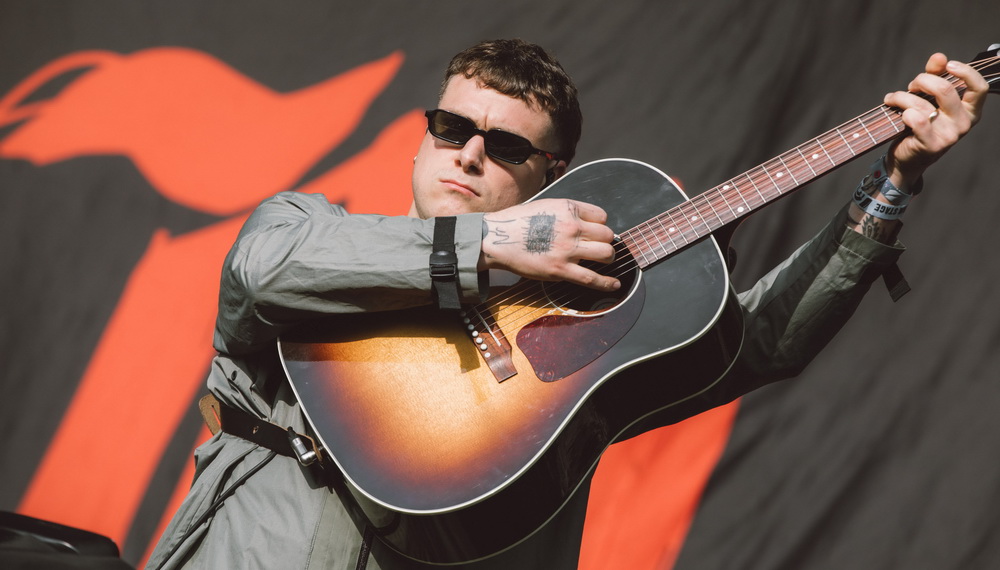
Taking to the stage, DMA’s enjoyed the weekend’s glimmer of sunshine and brought their all with both their old and new material, including popular singles Silver, Tape Deck Sick and Lay Down. Much to the audience’s joy, they also played their cover of Cher’s ‘Believe’, which now boasts over 41 million streams.
*****
Cover photo: Julia Schwendner
Photos: Courtney Turner
Photo gallery
*****
DMA’s pages


