 Messed!Up
During Manchester’s Neck of the Woods festival, I had the fortunate chance to talk to one of the event’s higher-profile guests. John Robb is the frontman of 70s punk outfit ‘The Membranes’, known for their dark disco grooves and spooky themes. John himself boasts an eclectic portfolio of music and writings. Starting with fanzines, he quickly moved into writing books and journalistic articles on music and culture. His passion and success led him to a number of TV appearances, featuring in several documentaries about the punk, post-punk and goth eras, and music and arts.
Among artists, John is particularly notable for his website, ‘Louder Than War’ – a hub for music and arts reviews and thought-pieces. He regularly shows interest in upcoming and independent artists and has a lot of insight into the various facets of the DIY ethos.
John’s latest book, ‘The Art of Darkness: A History of Goth’, celebrates goth culture in what he describes as the first comprehensive look at goth culture history. The book covers everything from 70s and 80s discos, Instagram, and even the fall of Rome. He has a writing style that is deliciously descriptive and loves to capture the reader by putting them in amongst the characters and stories he depicts. I would be interested to know how often the word ‘dark’ is used throughout.
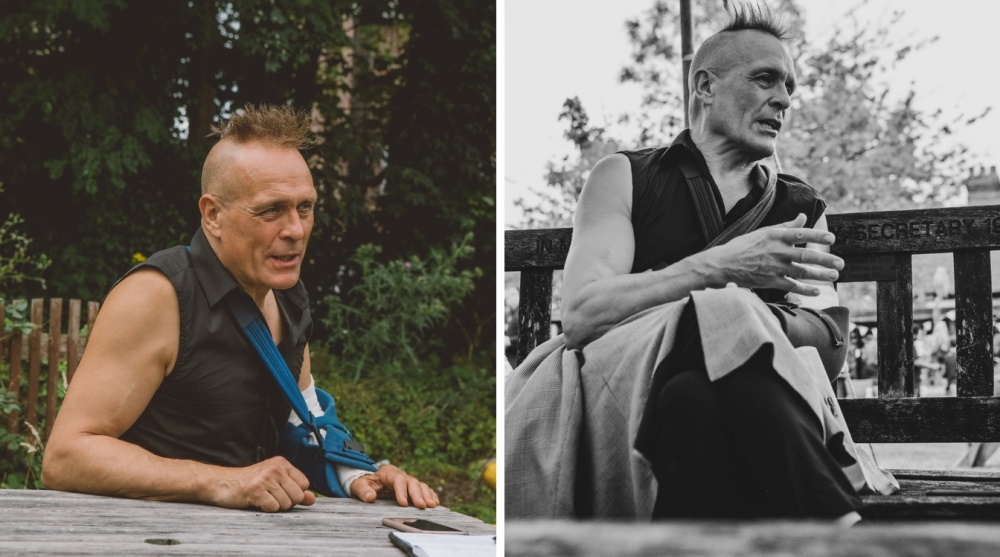
John showed up in the grey Manchester drizzle, muscled arms exposed and expression stern. As photographer Courtney described, he looked like “a real rock artist.” And yet, his entire persona was friendly and relaxed, and I didn’t once feel out of my depth during our chat.
When you first started The Membranes, your ethos was very DIY. I know you write about DIY artists a lot, and seeing you here today stands testament to that. What challenges did you face then that you see artists facing now?
First of all, I don’t think any artist really wants to be DIY, it’s just something that’s forced on you because no one else is going to put your stuff out. But I think it’s also good that you don’t wait for other people’s permission to make your art. I think that’s really important, isn’t it? Obviously, if it’s somebody that can subsidise it all, that would be fantastic – then you can just get on with the art, instead of having to worry about all the pressings and getting the distributing. But in the end, you realise that there are only very few people that are going to get that luxury, and everyone else pretty much spends their lives creating that space for them to create that art whether it’s your writing or your books, or your music. Generally, it always ends up being the same thing – that you have to do it yourself.
Although, I actually prefer the term ‘DIT’, which is ‘Do It Together’. You kind of work with other people, don’t you? I mean, you could do it as a co-operative – and I like the idea of co-operatives – but sometimes it’s just swapping phone numbers or tips, helping somebody out because you’ve got a connection somewhere. It’s DIT, in a sense.

So, I think anybody working in art – music or whatever – if they work together, they can create a bigger space for them to exist in. Because the people, often, who give the permission by having the money to make art, aren’t really the best people to have that power, are they? (laughs)
The other thing to realise is that you’re not really up against the mainstream. The mainstream’s a different form of culture. It’s not like a war against the mainstream. I mean, who cares what’s in the mainstream? It’s a different world. You know how some people still get upset by X Factor, and you think, “Why are you bothering about it?” You may as well get upset about – I don’t know – curtains! (laughs)
It’s an interesting point because I feel like – as a musician – I also get upset by the X Factor. But it’s more about celebrity culture, I suppose.
It’s not a music show, it’s about the judges. I mean, culturally, it’s shite – of course it is. And it’s bullying – it’s like TV bullying. It’s a load of old people – my age – bullying 20-year-olds, telling them how to do what they’re doing. Whereas, when I was 20, I would have never taken shit off a 60-year-old. I would say “This is how we do it, what’s it got to do with you?” It is kind of a bullying thing. So on all those levels, it’s wrong, but it doesn’t impinge on what you’re doing, does it? Our world’s here and their world’s there. I mean, you may as well get annoyed about Premier League football. It’s not attached to our stuff.
When you talk about not letting yourself be bullied, do you think that was a consensus among artists at the time? Or do you think that being a punk musician helped you to stand out in that sense?
In a sense, but punk was massive when I started. Punk was the pop music. People forget that, but punk wasn’t underground in 1977. The Sex Pistols were the biggest band in the country that year, and I like that, I like that idea. You see, that’s an argument against DIY, because they were on EMI, Virgin, whatever – they had access to the mainstream. If something like that gets to the mainstream it makes the world a better place, doesn’t it? If they’d been on an independent label there would just be a few people listening to it.
There’s always a danger of it then becoming quite a snobby thing – it’s just the people that ‘know’, and that – I hate that as well. Wild art should be available to everybody, shouldn’t it? And every now and then when it gets through, it’s pretty exciting. Like when Nirvana hit the mainstream. It was thrilling for a few months. And I know people go [he puts on a mock whiney voice] “Nevermind was watered down,” and you go “Well, not really,” it’s still quite a powerful album.
I suppose, when you see some of the performances they gave on Top of the Pops, for example, their attitude was against it.
Yeah, they were fucking with it. But they wanted mainstream. You can see in Kurt Cobain’s diaries, where he made those lists of things he’d have to do to get mainstream. But he did it on his own musical terms, so when he actually got into the mainstream, they still had the power and the emotion that Nirvana had.
Ah, that’s great, isn’t it? The moment I finally get outside, it starts pissing down.
[At this point, it started raining, and we had to relocate the interview. We found a sheltered spot under the canopy, near some of the festival’s stalls, and continued]

So, talking about money and separating the art from that; you are an author, a journalist, you were doing fan zines – and that was quite early on. Obviously, artists now have to have loads of different sources of income – I mean, none of us are doing this for our main source of income. People often talk about how tough the industry is now. Is that just rhetoric or has that struggle always been a thing? Have you done all that additional work out of necessity or passion?
I think more people do it DIY now because, digitally, it makes it easier. And because of social media, you can control your own media. But the problem with that is that everyone is doing it. So, I think that it’s worse for bands now because there’s more people in bands now. When I was growing up [in the punk scene] there was quite a healthy punk scene in Blackpool where I grew up, so that would be about 25 bands. But if I went back to Blackpool now, I bet there’s about 250 bands. I mean, everybody’s in a band, aren’t they? And most of those bands aren’t actually shit, they’re actually at a fairly good level. Six-out-of-ten bands, we always called them – they’re pretty good, but not mind-blowing.
So, the bar is raising up higher, and there’s so many people doing it that it cuts the slices of cake smaller and smaller. It’s almost become like a posh kid’s hobby – being in a band – because it’s really hard to sustain it, otherwise. Who can afford a rehearsal room? Well, there aren’t any rehearsal rooms in town, anyway. It’s harder to sustain being in a band now because there’s less space and more people doing it. But there’s still completely brilliant people popping up.
I think the playing field always changes – that’s the thing. But the weird thing is, it’s always changing, and yet it always seems the same. You can have all that social media, which is great. It has changed the way things are, but the way to get heard – if you’re a guitar band – is to get on support slots and support people, which is the same as it was in the 1970s. You still have to go and support people, get on the road, and engage people with your music. Obviously, if you’re electronic it’s a completely different route.
In a weird way, music – it’s not changed since 1955, has it?
What is your opinion on the rise of TikTok and social media?
Well, I like it! I mean, it’s good and bad, like everything is. It’s like how AI is good and bad, isn’t it? AI could end up being like Terminator 2, with the robots destroying the world, or it could be like having medical systems run by robots, looking after old people, making their lives much more comfortable. There’s a lot of advantages to it, but human nature seems to push it towards the shit, doesn’t it?
Social media’s the same. If you’re an artist, you can find a space to promote what you’re doing without relying on the gatekeepers – you can circumnavigate the gatekeepers, which is a good thing. And you can get in touch with the most unlikely people on social media, and sometimes they’ll get back to you. There’s examples of that, and that works well. But also, it’s full of complete tossers, who are under anonymous names, slagging people off and putting on bullshit about them – utterly libelous shit about people that, in the real world, they’d be sued to fuck for [saying].

Do you think artists have a duty to use their platform to spread positive messages in terms of political issues?
No, artists just have a duty to make their art. It’s a sad thing now – you know, like, Morrisey fans – they just don’t know where to turn.
What do you mean by that?
Well, because he’s obviously ‘gone to the dark side’, hasn’t he? But, if they still like his music, they should still listen to his music, because music is sort of beyond the person.
So, you believe in ‘death of the author’, then? Separating art from the artist?
Obviously, it’s better if the artist agrees with your checklist of things that you need, but then that would just be you, wouldn’t it? (laughs) You may as well make the art yourself!
Something that has been in the media a lot is this idea of cancel culture, where if someone said something bad, like, ten years ago, then now we can’t engage with them.
It’s a generational thing. In my generation – the punk generation – people would actually go the other way around. They would say the most outrageous thing possible – which they didn’t actually mean. It’s quite weird because I just did a book on collective journalism, and I edited the interviews and sent them to the book company, and they said, “Some of these quotes from Mark Smith or Steve Albini, you can’t put them up,” and so I said, “Well, why not?” And so they said “Well, people will see that as [unacceptable],” and I said, “Well, we don’t actually mean it, you know? They’re only saying that because they know that their audience is smart enough to work out that they’re actually just pressing buttons.” So, it was like a triple bluff. But people now take it at total face value.
I mean, at the time, when people like Steve Albini and Mark Smith would say stuff like that, I would challenge them face to face, I wouldn’t do it on Twitter like “Okay, I’m not going to follow you anymore,” which is a bit weedy, isn’t it? I would actually say to their face, “Well, why are you talking shit like that?” So, you can say it if you want, but I’m going to argue with you. I have the right to disagree with you, as well as you have the right to say it.
The curious thing is, Steve Albini now is the complete opposite. He says he’s very embarrassed about the stuff he used to say, and he’s actually very woke these days. (laughs)
What do you consider woke? Because it’s a word that is kind of thrown around a lot.
I know, it’s a shit word, isn’t it? I think, actually, in the punk times, people had the same opinions. People would be very kind of, whatever you want to call it – woke, and people would be anti-racist, anti-sexist – all the good stuff. But people would also say totally outrageous things just to annoy people. I guess it’s a different nuance. So, when you see a picture of people in The Sex Pistols crowd wearing swastikas, they’re not Nazis – everyone knows they’re not Nazis, everyone knows they were just doing it to wind people up. Whether you agree with that or not is different. But they were not Nazis. Whereas now, people would look at those pictures and think “Well, I can’t listen to their records because they were obviously Nazis.” It’s a generational thing – every generation has a different way of dealing with the world.

Do you think it’s a bad thing – the way that has progressed? Or do you think it is just natural?
I think everything just changes, but I think it’s kind of weird. In the punk days, people like Mary Whitehouse led these campaigns against people being outrageous, or whatever. And now, it’s like the other side running those campaigns. It’s the conservatives who usually try and ban the people who are more on the left – or whatever – for having these outrageous statements, and now it’s the people on the left trying to ban them. It’s kind of weird, like it’s human nature to ban things. Whereas I just think to get it out in the open, but shout the [other] people down, and just say “You’re talking shit.” Have the debates.
But I know that’s easy for me to say because I’m a white bloke. I’m in a more powerful position.
I think that is a good thing to consciously understand. I think a lot of people won’t take that step.
But, I mean, most of my friends who are women will say the same thing. They say, “If a bloke said that to me, I’d just tell him to get fucked.” It was a different time, wasn’t it? People would say it to your face. Whereas now people just go and unfollow you on Twitter, which is a bit weedy.
I know why they’re saying that, and it’s right. I wish the world wasn’t full of people saying stuff like Morrisey says. But then that’s just the cycle of life – people just end up old and grumpy and talking shit. I’m amazed by some of my friends, I think “Jesus, what happened to you?” (laughs)
I suppose you’ve got to enjoy the art and the stuff that you create.
Yeah, I separate it. A lot of the greatest artists ever are completely horrible human beings, aren’t they?
It doesn’t mean that, like – if an artist you like murders someone – it doesn’t mean you personally condone murder, does it?
No, I don’t think so. I suppose it comes down to someone’s individual choices as to whether they want to support that artist.
People know too much about other people, as well. In the 1970s, you wouldn’t know that much about the people whose records you listen to. You’d just kind of assume that everyone’s on the same side, and then you realise they’re probably not, most of them. And also, artists aren’t any more qualified to have any idea about the world than some pissed-up 55-year-old in the pub.
I suppose we see that a lot with online influencers and similar personalities who have these platforms where they tend to say their opinions but they’re not necessarily right – often not.
It’s interesting ideas that make the world a better place, to me. The platforms that I’m now using – I do all this stuff and I’d rather do it in those worlds. With the more green and eco stuff that I get involved in, I’d rather work with those people who have really good ideas. They don’t make music, they’re just very good at doing green and eco stuff.
Is there a connection there between your music and your environmental interests?
Well, there is for some people, and it’s a sort of vague platform for ideas – music is quite assertive, really, at its heart. And also, it’s not a very green industry, is it?
Especially not if you’re Taylor Swift.
Going to a gig – it’s not very green. It’s quite hard to make it green because you have to get there, the audience has to get there, you need electricity to make the noise. But then, on the other hand, it’s a really important part of being human – it’s the ultimate communication. What music communicates is far more than a slogan, it’s something more powerful than telling people in the audience how to behave. It’s more primal.
Let’s talk about your book. Goth – why was that a thing you were really drawn to?
I really liked the music when I was growing up. Because, obviously, I was a glam kid and I was massively into punk, and then goth was one of the roots that came out of punk. And I liked a lot of the roots that came out of punk. I like post-punk, and you get books on post-punk that completely skipped all those bands, or treated them like they’re not very interesting. And I was thinking, a lot of these bands are basically the best art rock this country’s ever produced, so this needs embracing. And I thought I’d better go and embrace it, and so I did.
Goth has always been relevant but it has come back in a big way recently. I think, in many ways, it has almost become mainstream. I know people who will wear one black item and say they are goth – which I don’t think is necessarily a bad thing or wrong. But where is the line? Do you think it’s more of a sensibility? Or a style?
I guess the thing that holds it all together – black is the main colour. But – politically, socially, musically – everybody in it is different. And at the time, when there was the scene, people weren’t really … it didn’t exist – it wasn’t called ‘goth’ then, it was just post-punk or punk. Most of the bands thought they were punk bands. Bauhaus thought they were a punk band. It’s a retrospective term for a scene that already existed. It was like a piss-take term.
About two years after the whole thing had sort of started, all the bands were going, “We didn’t form this goth band.” I mean, Siouxsie Sioux didn’t start a band to be in a goth band, she started a band to play The Sex Pistols in ’96 – there was no such thing as a goth scene then. That’s why they hate the term. And also, people start saying [a cockney accent], “If you’re a goth band, how come you’ve got white trousers on?” (laughs)
Obviously, the image is a massive thing. But where did that sound cross-over? And where did people start identifying that as something different?
I think there was a darker, more melancholic vibe in disparate bands. But some people were toying with it, some people were making music that was melancholic without being melancholic [themselves]. You could dance to it, as well – that’s the bit that everyone misses out on. It was about the dancefloor. A lot of the bands would actually have black music influences – there was funk and there was dub. There was disco mixed into it, as well. It’s something people don’t often think about, but goth wasn’t morose people moping around in the corner of a club, people were dancing. It was a sexy scene, it wasn’t loads of people going, “Oh, woe is me.” (laughs)
Do you think that conception is detractive from goth?
You can embrace the darkness without being swallowed up by it. What’s that great saying? ‘He who embraces death celebrates life.’ Yeah. You have no idea how brilliant life is until you realise what death is, you know? It doesn’t make you a morose person to realise that this is not infinite. The minute you realise it’s not infinite, suddenly, everything goes into technicolour.
Why is this something you decided to write about now, in 2023?
Well, it’s been ten years since I started the book, on and off. So it wasn’t like an overnight thing I knocked out.

So, you did it gradually as things came in and out of fashion?
When I had time, I did whole chunks of it, and then there was a few holdups before it came out.
And you have written a lot of books, as well. You have been heavily involved with journalism with your site, Louder Than War. I read some of your reviews, on there. As someone myself who has to balance art and work, do you have any advice for people who want to embrace the different elements of art and culture? About how to get into it and manage time?
I think, if you’re a music writer, always trust your instincts – it’s not like normal journalism. It’s not about fact, often, either. It’s about what you feel. That’s a bit different, isn’t it? If you’re reporting on a news story as a news person – like a journalist, in a sense – you have to write the facts, or how you perceive the facts to be. But I think in music, a lot of it is about feeling. I mean, obviously, you put the names of all the people in the band, and all the little factoids, but really it’s what you felt about the gig, and what you feel about the music. And what the other people in the room feel about the music. Then you contextualise it – why is it here? What are we all doing here? Why does this resonate with me and other people? Which is eternally fascinating. That’s, to me, music writing – it’s writing, not journalism.
I feel like – yeah, that’s a really interesting way of looking at it. I need to read your book.
[John then taps his bag] I’ve got it here.
*****
And so, I bought John’s book. He actually gave it to me with the trust that I would pay him back for it, and not before asking whether it was okay to charge me the fee. Of course, I obliged, and he even signed it for me, addressing it: ‘To Tom, from John Robb’, drawing a quick face on the page, complete with a tuft of spiked-up hair and a performative moody frown.
In hindsight, I wish I had delved deeper into John’s thoughts on people being ‘weedy’ by not confronting those they find offensive online. I think there are many good reasons why people do not want to see this kind of content on their timelines, and I think freedom of speech can be a dangerous topic if left unchecked. But, I do believe that John’s assessment of this is well-intentioned: solve the problem, don’t just ignore it and hope it goes away, I suppose. Obviously, the issue is more nuanced than that, but you get the idea.
John Robb is as punk as punk gets, taking matters into his own hands instead of allowing controlling companies to close their hands around his passions. I think artists and consumers alike can learn from his attitude and experiences, and you can find out more about him by visiting Louder Than War, or purchasing his book, which I will be enjoying over the coming weeks.
Huge thanks to John for taking the time to speak with us. I will be looking to catch The Membranes next time they swing by Manchester.
Photos: Courtney Turner
*****
John Robb pages


