 Messed!Up
Artistic creativity retains an aura of mystery, something just a few people have in their DNA, and is accorded special value in society for its ability to challenge, inspire and transform; “one of the highest-level performances and accomplishments to which humankind can aspire” a professor told us at a conference during my PhD studies in music. People being in possession of “artistic creativity” and having the ability to “embody that creativity” should be seen as uniquely talent, someone with skills way beyond ordinary human abilities. The general idea of artistic creativity is that you can express and communicate it on record or on stage in ways that are intangible; the audience just knows it’s something special (leaving it open for individual interpretation).
The moments you encounter artists expressing or communicating this type of creativity are rare, especially those moments when music “speaks” to you, like a supernatural language that only you understand. The last time it happened was last year when we ended up at Above Songs Festival at Knust in Hamburg to cover Blaudzun’s performance, but the opener caught our interest with his unique emotional solo performance, walking the line between anxiety and vulnerability on one side and a warm sense of humor on the other.
When John Van Deusen returned to Hamburg we hauled him in for an interview the day after his headCRASH show at Reeperbahn Festival, and talked about punk music, his latest album in his “(I Am) Origami” series, emotional music and preparing for fatherhood.
But it all took off in his parallel career as a punk bassist in Descendents-sounding band Buffet.
The love of punk music
I just found out that parallel to your solo career you also released a great debut album with Buffet. That’s some really good Descendents like punk music on “All-American”. It’s all very different from your solo music.
It is very different, yes. It’s a lot of fun to play punk music and I think my love of punk music informs my solo music, a little bit. But Buffet represents a kind of convergence of anger and humor, just trying to laugh at the absurdity of the world, and obviously it’s a way to show our love of hardcore punk, especially punk from the eighties like Descendents, Minor Threat, Fugazi and that world of music.
When we were writing and recording that record, and we recorded it in just four hours, I was listening a lot to “Milo Goes To College” [Descendents debut album]. It makes sense if you hear Descendents on that.
I loved that album when I was young in eighties.
Are you familiar with this tattoo [John showing a tattoo on his forearm]? Do you know what this is? They started as a punk band, a seventies punk band but they grew out of the punk scene; they’re called XTC, from Swindon. This [the tattoo] is the cover of “English Settlement”.
They wanted to be a punk band but they loved The Beatles, The Beach Boys and The Kinks so much that they couldn’t really be a punk band. That’s my favorite intersection of music (laughs).
You made four albums with The Lonely Forest before you embarked on your solo career. Was it a big step in the beginning to go solo and not have bandmates to rely on?
It was different but it allows me to take more risks. If I make a mistake it just reflects me poorly, it doesn’t reflect the other members poorly, and I think when you’re allowed to take more risks you find more interesting results.
It doesn’t always work well but as a solo artist you can you can stretch and bend things a little bit farther.
But the creative process is also different. In a band you have input from other band members.
True, but it’s more about me writing and recording in a vacuum. The drummer on my solo projects and in Buffet is the drummer from The Lonely Forest, Braydn. He plays on everything that I write and record. I do think that’s why you can hear some similarities between everything.
To be fair, I wrote the songs to Lonely Forest so it makes sense that there will be some similarities between my solo music and The Lonely Forest. But in general I have more room to breathe as a solo artist.
“People often leave my shows feeling very introspective”
Following the “(I Am) Origami Pt. 2 – Every Power Wide Awake“ release in 2018, Van Deusen returned in July this year with his third record in his (I Am) Origami album series, “A Catacomb Hymn”, released on Hamburg’s DevilDuck records.
On his new album he takes a step in the direction of “radio rock” – or power pop as someone suggested – continuing his distinct American sound but with all the anxieties and existential mysteries still in his lyrics. And the anxieties make Germans uncomfortable.
Music-wise you follow more of an American tradition than a European if you ask me, but you ended up on German DevilDuck Records. How did that happen?
Jörg, who started and runs DevilDuck Records, first saw me play at South by South West in Austin, Texas, and that was a Lonely Forest show. He had tried to re-release a Lonely Forest record in Germany because he was working for the same label we were on in the states – we were part of the Atlantic Records – and Jörg was working in the rock department here in Germany, but it just didn’t work out with the label.
Then a radio DJ in Seattle, who had played some of the other bands on DevilDuck, randomly found out that I was going to be visiting Germany because I love Germany so much, and he suggested I get in contact with Jörg.
I didn’t know that Jörg knew who I was already, and I sent my first solo record, part one of “(I Am) Origami”, to Jörg and he thought “Oh, this is John from The Lonely Forest, I’ve been wanting to release his music in Germany for this whole time”, and that’s why I signed on with DevilDuck and why he agreed to release this first record and the third record.
When you released your first “(I Am) Origami” album, had you already planned for a series of albums or was it something that happened organically while you were making music?
I always wanted it to be an album series that reflected a wider spectrum of genres and sounds, but I wanted it to be taken as one piece at the end of it. When it’s all finished and said and done I want people to see it as one big art project.
Meaning that it is different concepts or just like origami.
Exactly! The idea is that when you create origami you take a paper and you fold it to one shape, and then you take the same piece of paper and you can fold it into another shape. That’s how I feel the records are.
The first one is me trying to make a pop record, the second one is me trying to make an experimental prayers record and the third one, the latest album, is me trying to make a radio rock record from the nineties. That’s the kind of idea with it.
You can have an origami crane or an origami dragon but they’re both made from the same substance.
And the album series continues with a fourth album before it’s done?
I’m trying to decide right now if it will be four or five.
How personal is songwriting to you? Most lyrics seem to be about yourself and personal anxieties.
They are. I think most of my music reflects either depression or anxiety, or in the better moments probably just mystery, just like feeling like our existence is mysterious and asking a lot of really big questions about existing in general. So yeah, I tend to put a lot of myself into it and that makes for an emotional experience, which I will say makes a lot of Germans uncomfortable (laughs).
To be quite frank, if there’s a reason why my music wouldn’t take off in a place like Germany, I think it’s because of that very aspect. Especially when I’m playing by myself the experience could be really emotional and it’s not the most comfortable thing.
I’ve noticed that people often leave my shows feeling very introspective, almost like they’re overwhelmed (laughs). It’s not a very marketable experience.
I was about to say that. Watching you live is just like seeing someone bringing the lyrics alive on stage. We were at your show at the About Songs Festival last year and you seem to be in your own bubble on stage. How do you experience the feeling of being on stage?
I don’t know to be honest. I have done it enough because I started performing when I was fourteen. I just think I have developed some certain habits.
But I am in bubble in ways, and the stage banter, when I talk between songs, that kind of takes me out of it and suddenly I remember that we’re all together and it’s a collective experience. I also try to make light of the fact that my songs are so emotional and oversincere. I like to make people laugh to kind of diffuse some of the tension in the room.
For me, in a really abstract way, it’s worshipful because I believe in a creator, and when I play music, whether I’m playing a song that’s super sad or I’m anxious or I’m angry or really joyful, I’m communicating with something bigger than myself. So on stage, if I’m doing it right, I’m kind of lost in that essence.
Preparing for fatherhood
As I understand it this is the longest German tour so far in your career. But how is it different to play Germany than North America?
It is a little different I think. In some cases my songs are too wordy, I just use too many words in general. If an audience has English as their second language, sometimes some of the nuanced aspects of the lyrics can be lost.
For example last night [at Reeperbahn Festival]; being able to play with the band makes it easier to share the energy of the songs with the crowd, and I think that band sets work out better here in Germany.
This could be a terrible stereotype; I don’t think Americans enjoy discover new music like the Germans do, they’re eager to hear new music. In the States it can be really hard. If you play in Philadelphia or Washington DC and three-quarters of the crowd never heard of you before it can be kind of rough because I think that Americans are less receptive to hear something new. I feel that they want something that’s familiar and I also feel – and this is terrible to say – that we want to be told what to like. We want to have a stamp of approval by someone before we’re able to open ourselves up to it. Of course not always, but in general it’s a trend in America with music.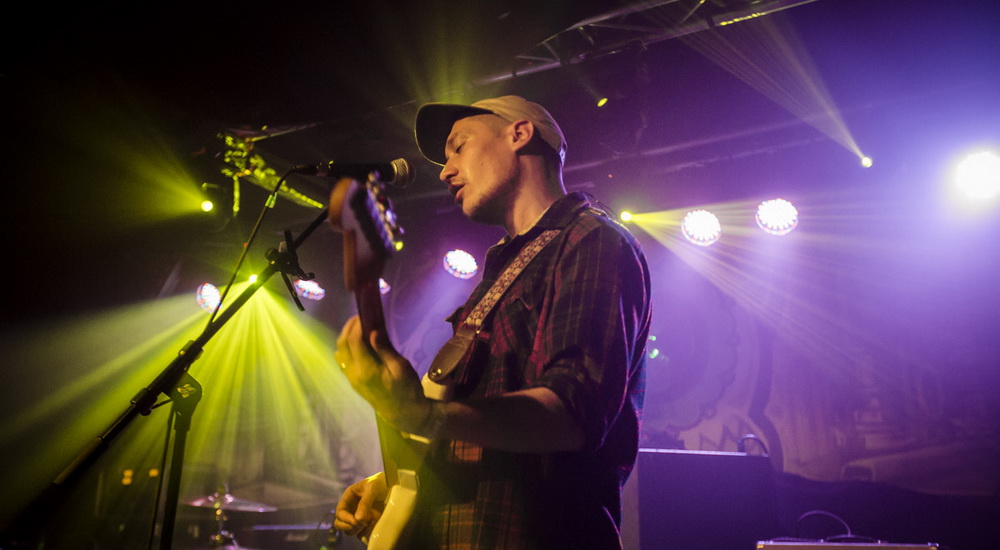
And what will happen after the tour? A new solo album or something with Buffet?
Buffet will write a new record. We’re one of those bands that play like seven times a year and every time we play we feel like we get better, but we don’t practice. Inevitably, out of that, grows more music. I will say that the newer music we’re writing are going to be more in the Fugazi direction than a Minor Threat direction, and I’m really excited by the future of Buffet.
For me and my solo music I have all the songs I need. I actually have a whole record recorded that I need to sift through and decide what I love about it and what I don’t, but I will begin to work on part four.
My wife Annababe is pregnant and I’m also preparing my head and my heart for fatherhood and some sort of a break; a different type break, from performance perhaps but not from responsibility (laughs).
I already started writing songs about the mystery of passing on ourselves into another person. You pass on so much, not just the tangible aspects of people like my looks but also certain parts of our personalities, and that blows my mind.
And it’s going to be a punk kid?
Oh, I hope so! It’s a boy and he’s getting all that loud bass fuzz every night when Annababe plays and I’m hoping he likes punk music, but he may not. Maybe he’s so battered from all the loud noise that he’ll come out just wanting to listen to nice classical music or ambient music (laughs).
Photographer, interview: ©Teresa Enhiak Nanni
Photographer live: ©Mandy Privenau
Photo gallery
John Van Deusen pages


Messed!Up recommends
