 Messed!Up
Among the range of artists playing Neck of the Woods festival was organiser Sam Brunt’s Big Cat Chic – a band whose genre is difficult to pin down. Sam and the other members of Big Cat Chic have been in the Manchester music scene for a good amount of time. Sam’s back catalogue includes playing bass for alternative rock band Jekyll and his previous psyche-rock project, Suave Martyrs. Another particularly notable figure in the band is Jamal Lewis-Service, who also drums for jazz ensemble Nguvu. Fronted by Eliza Waite, the resident punk enthusiast and doubling gig photographer, I had caught Big Cat Chic between bass players, so Charlie Krell had stepped in for their festival slot.
With their eclectic line-up, Big Cat Chic’s multifaceted members bring a range of experiences and views on the music industry, specifically that surrounding Manchester.
Having already spoken to Sam previously about the intricacies and struggles of arranging the festival, I now hoped to learn more about such from the artists themselves. Playing your own festival must breed a fresh sense of pride – or nerves.
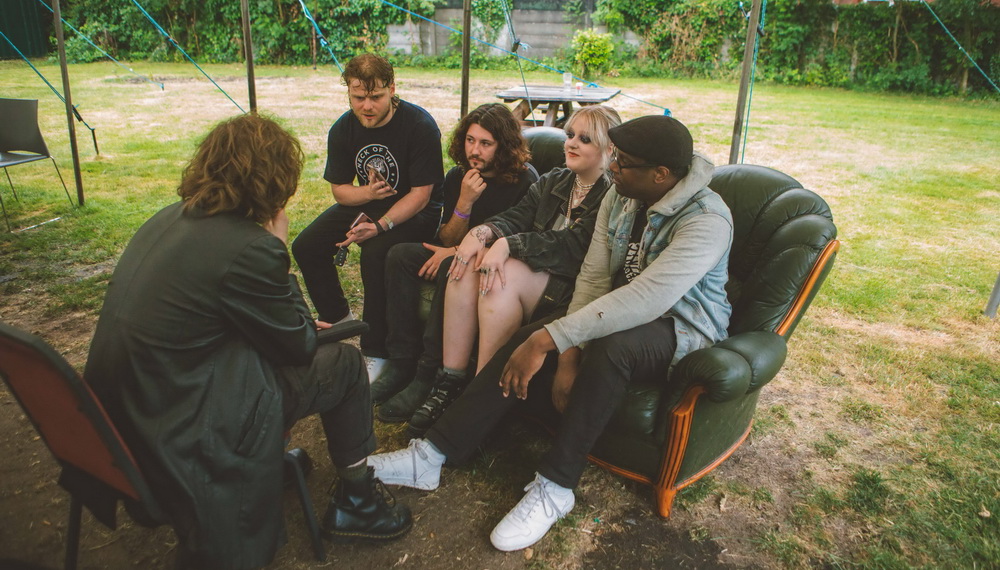
We pushed an antiquated sofa towards a back corner of the outdoor canopy, and between the pitter-patter of an oncoming thunderstorm and a group of drunk musicians loudly singing some pop and country classics, we sat down to chat.
I have seen Big Cat Chic play before in a more infant stage, I know you all have and have had various different projects, so I want to establish who and what Big Cat Chic is. Is it fair to say that, Sam, you are the creative drive behind the band?
Sam: “Not necessarily, I mean, there’s a lot of different drives, I would say. Eliza brings the punk aesthetic and elements, Jamal’s bringing loads of different insane rhythms from various different genres. And so, yeah, it’s quite a meld of stuff.”
Where do you feel that Big Cat Chic fits into the wider Manchester scene? There’s definitely a sea of indie artists at the moment. [at this, Jamal makes an exaggerated expression of exasperation]Sam: “I would say, we probably don’t [fit in], necessarily.”
Charlie: “This is the furthest fucking thing from Manchester [norms].”
Sam:” I would say, because we’ve got such a diverse range of [influences). Jamal plays in Nguvu which is a funk and jazz-fusion band, Eliza is a kind of ‘riot grrrl’ aesthetic, and I’ve come from ‘60s elements, and then Charlie brings a heavier influence – it’s difficult to say whether we fit in anywhere, necessarily. But we could sit on quite a few different bills, quite happily, from heavy rock, even into the more funky elements and that kind of stuff.”
Eliza: “I think we fill the gaps.”
Jamal: “And just to add to that, as well – our place in the Manchester music scene – being different from what you would typically think of from a band in that scene is something that is so needed. It’s so needed because, for the past … probably for as long as I’ve been alive, the music scene [here] has been oversaturated with just one genre. Or, at least, one genre has been showcased where a lot of other music and musical styles of other cultures have been marginalised and forgotten about, and that includes the punk culture, as well.
So having the different elements and people who bring different things to the table … I don’t want to call it a melting pot, it’s more of a ‘delicious salad’.”
A delicious salad? I like that.
Eliza: “A fruit salad.”
Jamal: “A fruit salad, yeah! (laughs) One of your five-a-day – basically something that’s needed for, especially for me – the dietary requirements of the music scene. And something to say, ‘Look, you don’t need to try and blend into what is [typical of] Manchester music, you’re better off standing out.’ It may be difficult in the short term, but in the long term it will work out.”
Charlie: “If you don’t diversify, in any industry, you’re fucking dying. And in Manchester, the thing is, bands and music, in general, have, I think, been pushed towards one side because of modern [issues]. So you’re fighting that. And because you’re fighting that, the bands there are very similar – a bass player, a guitar player, a singer, a drummer – and play the same kind of music. Anything different is what’s good, really. It helps to have something that catches your eye, you know? Performance-wise. And when you’re listening to music – I don’t know anyone who just sits and listens to the kind of bands that are in Manchester all the time. You want flavours.”
So, who do you want to be playing with? What circles do you want to be getting into?
Sam: “We played with Nguvu last month – that was fantastic. At the same time, we’ll go on stage with someone [on the other end of the spectrum]. We said we’re different to a lot of the Manchester scene. That’s not to say there’s not great bands in that scene, but it’s all about having a diverse range of what is out there. So, I think in terms of what we give, we quite happily sit across different bands’ [sounds]. In terms of bands we’d want to play with, because we’re so open to playing with other bands, I would even want to pick one out off the top of my head.”
Eliza: “I’d say it’s more about being different. If another band has the same kind of – I don’t know – vibe? Not genre-wise, but if they make music because they like making music, not just because they’re trying to fit into something, then that’s what we would go for, mainly.”
Do you think Big Cat Chic will stand out more for doing that? For coming at it from a different angle. Or do you think it will be more difficult?
Sam: “From my perspective – not necessarily to get into the scene, because anyone can get into the scene, to a certain extent, but it might be more difficult for someone to take a proper punt on you with cash which is essentially what you need to push yourself forward through the industry, at the moment. At the moment, money talks. And so, if you are a bit different, it does make it a bit more [difficult]. But, you only need that one person to give you a chance.”
Jamal: “I think, just to add on to that, I think the most important thing is – rather than trying to get into the scene – rather than trying to follow, try to lead. Try to create your own niche, create your own scene. For example, you probably haven’t heard of it, but I know a lot of people in the afrobeat community, they’ve done their own thing and they’re selling millions of tickets to shows. I grew up in a very Caribbean-Jamaican community, and we had places like the Rastas’ HQ where, even to this day, it has a very tight-knit community that still is thriving and still has young people playing Caribbean music.
But, going back to [the question], [it’s about] making a scene that is equally as welcoming, but as much can say, “we’re not trying to be something else, we’re trying to be us, and there’s no one else that can be us.”
There’s a lot of cross-pollination between genres at the moment. For example, the importance of pop is often overlooked when thinking about rock and punk. In Big Cat Chic, you have a lot of influences going on. Do you think cross-pollination of genres is something you want to promote? Will we hear a lot of those influences in your music?
Sam: “I mean, pop is fantastic. If you look at The Sex Pistols – they were taking stuff out of Abba. So, in terms of what pop music can bring to alternative music, it speaks for itself There’s absolutely loads of stuff. Look at Lizzo, at the moment, it’s unbelievable. There’s loads of pop artists that are using pop production in an alternative way. So Lynx, who is kind of non-binary electronic stuff is doing unbelievable shows that absolutely kill [ticket sales] every night, using pop as a basis. Pop can absolutely have a massive influence on alternative music.”
What is the biggest challenge in getting a new thing started and off the ground?
Sam: “For me, it’s gaining momentum – getting that first gig out of the way, those first few, and then you start going, ‘Oh, okay, there’s people coming now. Where can we now push it?’ Whereas, getting that first initial push is probably, for me, the hardest bit.”
Eliza: “I think, the hardest thing is trying to find the right people, and being able to motivate those people. I mean, Big Cat Chic has had a couple of members drop out in the first three weeks. It took a while to find committed people.”
Charlie: “The background music here, and the water, is just fucking phenomenal – this is a great interview. There’s a lot going on, it’s rock ‘n’ roll!
I’ll say, I’ve played in a few different bands with Sam over the years, and to get that initial momentum, you’ve got to have drive, constantly. Every gig has to matter, and you have to really go for it all the time. You don’t give up, you keep going, and going, and going. And like Sam is talking about, when you get something, you can be like, ‘Oh, we’ve got something, and now we can do something here, and change this, and try [something different] out,’ but you’ve got to establish yourself [over] a year or two.”
As Big Cat Chic, you do not currently have any music out, so why are you focusing on gigs? A lot of people would say that the most important thing is to get your music out there and promote it with the gigs.
[It starts to rain very heavily. Thunder rumbles through the humid summer clouds, and lightning flashes in the darkening evening. Stored water pours from the sides of the canopy and creeps along the ground towards us. The raucous laughing and singing from the crowd near us gets louder]
Sam: “Don’t ever, ever, ever get music out without gigging. You need to be tight as fuck. [The other’s agree with a collection of ‘yeah’s] There’s so many different elements that you find when you’re playing live that you didn’t know that [could have happened]. And, sitting on a couch as you’re getting absolutely pissed on [by rain] – it’s a formative experience of being in a band! (laughs)”
Charlie: “You’re on Logic Pro in your bedroom – this is not that! It’s better, you know?”
Jamal: “I think it’s also best to get yourself out there and show your faces to audiences because, again, gigs are a lot more interpersonal than just, you know, handing out CDs or [promoting] streams. I think once [the audience] get to know the people behind the band, [they will] get behind the band and listen to the music.”
When you are looking at combining the digital side of things – social media, streams – and the physical side of things – getting in front of people and playing – would you say that you can’t have one without the other?
Sam: “They’re all assets of allowing you to find new people, and that doesn’t have to be a cynical thing. You can go and create a community of people where you just talk about music and you all support each other’s music, especially with social media. If you do have fans, you can give them something, because they’re looking at your social media, that no one else is getting. It’s all assets to be able to connect with people, and not utilising one or the other is narrowminded, frankly.”
Charlie: “There’s nothing more Mancunian than that guy [over there] holding a Chester Zoo umbrella and wearing an Oasis t-shirt.”
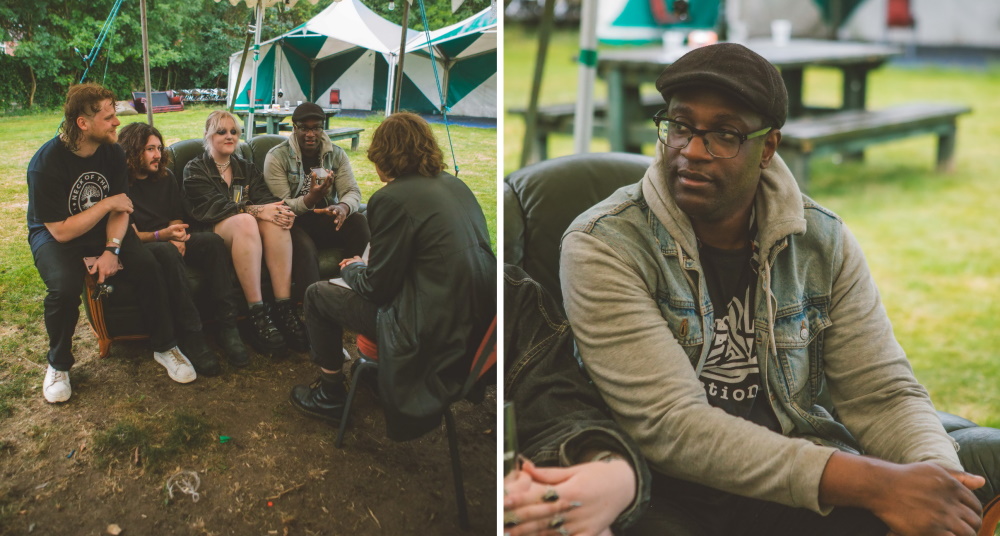
Jamal: “Moving on. [He sighs, humorously], I always say, try and have all your bases covered. There’s so many elements. There’s probably one thing that you’re particularly good at, I’d say look at everything. But, first and foremost, really talk to people. Talk to people about what you are, what you’re about. I say this from a personal standpoint – the best way you can get anyone to invest in what you’re doing is to really talk passionately about what you are, what you’re about, what you feel about your music – this, that, and the other.
All the digital stuff can build upon that. Obviously, you need to have your socials and your marketing and everything on point. But, I always say, word-of-mouth – tell your friends, even tell people like yourselves in interviews what you’re all about because you’re never going to get anything more pure and straightforward than from the horse’s mouth.”
Charlie: “To add to that, as well – because we were talking about the initial stages of Big Cat Chic – at the beginning, most bands are all about word-of-mouth. And then, maybe when you do get somewhere after a couple of years, that’s when your socials and stuff really take over, because then you’re getting what you’ve got to a much bigger audience. But, at the beginning, and in the Manchester scene – word-of-mouth is a big thing still, today.”
Following my various chats with Sam about the festival, it is clear that Big Cat Chic is an amalgamation of the creativity that he is trying to cultivate in his own little corner of Manchester. From the band’s history, I have high hopes for Big Cat Chic. While we typically cover bands with a more cemented role in their scenes, I think it is important to revisit those underground artists who are forging something new, especially when they make up such a large percentage of Manchester’s cultural foundations. For now, you can explore the members’ other projects by following the links above, but you can be sure that we will be revisiting this band in the not-so-distant future.
*****
Photos: Courtney Turner
*****
Big Cat Chic pages


