 Messed!Up
You want punk attitude, twisted political street poetry, and grating electronics that will make your ears still ring two days after the live show?
Many decades have now passed since the punk era, but its ethos of rebelliousness and experimentation has trickled down through the ages and survives in a surprising number of electronic artists today. Modern punks of electronic music don’t quite form an active, homogeneous movement in the same way that the original punks did in the 70s and 80s, but they share a similar mindset and speak up about similar problems in today’s society. It is most definitely visible in the primal energy of German band Kochkraft durch KMA, whose live sets always end up somewhere between chaos and riot, and the band have also started to carve out a space for themselves in a cis-male world, campaigning for involving more FLINTA+ artists [the German abbreviation for LGBTQIA persons] in the German music scene.
Last year, Kochkraft released their second album, the electropunk and techno-tinged Alle Kinder sind tot, and brought the album on a nationwide tour that continues into 2023 and has earned the band big festival slots at some of Germany’s finest festivals.
Messed!Up met up with band members Lana Van da Vla and Nicki Frenking a few hours ahead of their gig at Habitat Festival in Hamburg, and ended up in a chat about the need for punk music in 2023, embracing your inner child, and diversity in the German music scene. And please, do not miss an opportunity to catch the band live – you’re in for a treat!
When I started listening to Kochkraft a few years ago – when I finally could understand German – I realized that you’re quite a political band in terms of lyrics. Your latest album is called Alle Kinder sind tot which means “All children are dead” in English. What does the title mean to you?
You can read it in two ways. First, it’s a critique of how we live our lives today. If we don’t stop killing our planet and start taking care of our environment, we will all die. We may live fairly normal lives but there won’t be anything left for our children.
Another way to read it is that we all have lost our inner child. Wouldn’t it be a great idea to take a step back and be more curious and open about new things, just like children are? Children are always happy and seem to have more fun than adults, and we should embrace that even when we get older. If we would be more like that, we’ll have less egoism in the world.
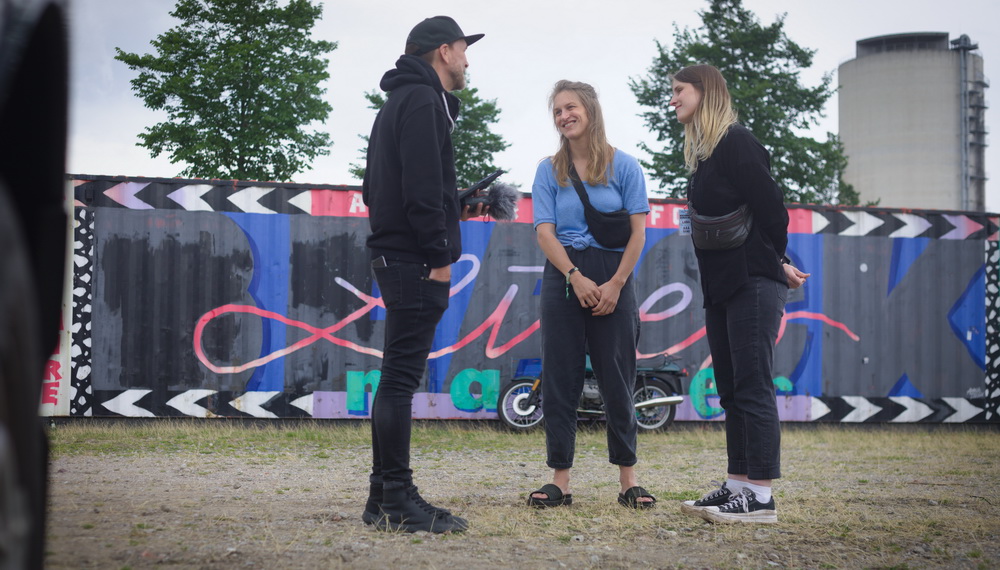
Embrace your inner child and take care of the environment, that’s what you can read into it. We need to stop taking everything so seriously and be more childish, without being stupid as kids may be at times. Otherwise, we’ll get bitter. (laughs)
That’s interesting and I recently had a chat with a friend about embracing your inner child and focusing on the fun in everything I do, but I find it so hard to see the fun in stuff I’ve done over and over again, for instance going to the hundredth festival. Life experiences take away a bit of the fun, doesn’t it?
No, it’s still fun! (laughs) We don’t agree at all! We quite much love festival life, maybe because we’re a band that you should watch live. Our shows are quite weird at times with lots of crazy things happening on stage, like our drummer speaking with a high-pitched voice in a very absurd way – that’s about embracing your inner child.
I also know that you’ve done lots of work for gender equality and to get more FLINTA people into the German music scene, like the Cock am Ring campaign. Although I haven’t discussed it at great length, some female German hip hop artists I’ve interviewed pointed out that there’s toxic masculinity in the German scene. How big of a problem is it in Germany with equality in the music scene?
As we understand it, from what’s in the newspapers, Germany is a lot worse than most other countries. It’s hard to compare for us because we’re only booked for gigs in Germany and don’t play outside the German-speaking area, but it seems to be a lot better in most other countries in Europe, especially for FLINTA people.
I [Nicki] thought about it a few days ago, you know this whole discussion about diversity in society in general that got lots of attention for quite many years but then started to fade away. And I wonder if we’ll see the same thing happening in the music scene as well where people will think “Yeah, we’ve done our homework, let’s go back to how it was”, like it’s a pendulum that swings back and forth. Sometimes it feels like body positivity and gender equality, and involving FLINTA, are issues we deal with in the music scene for a period of time, and then it fades away.
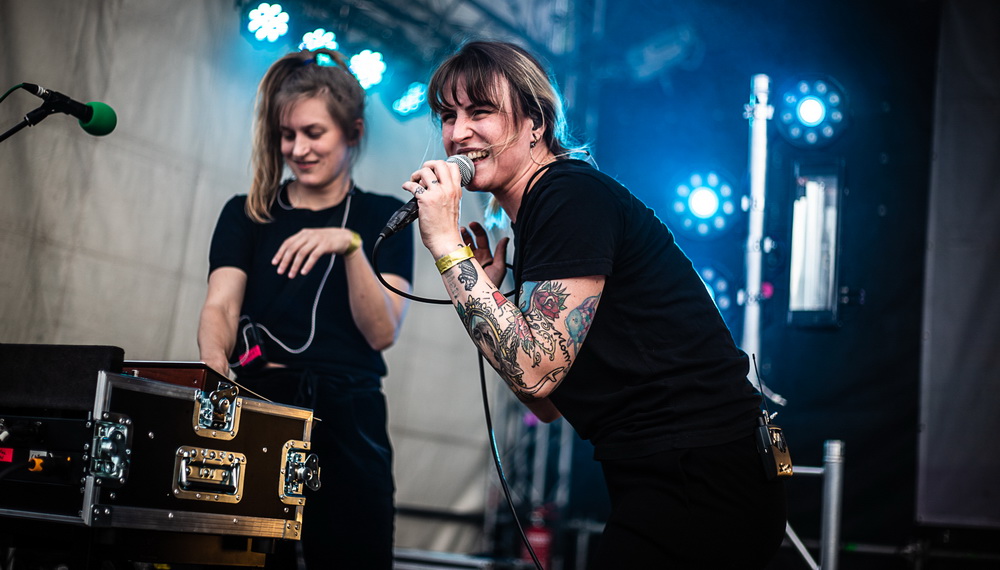
But the live music scene is a lot more complex after the pandemic. Bands in Germany haven’t been able to meet up and rehearse for almost two years and then it’s not easy for anyone to get booked for festivals. The pendulum has swung back after the pandemic, not necessarily because of less interest in gender diversity but because it’s tough for new or small bands to get gigs. They should get it if you ask me, but festivals also want to sell tickets. That’s the reason we only see old, male bands on headliner slots after the pandemic.
But again, I don’t know the numbers because the music scene just restarted after the pandemic – last year wasn’t good for anyone – and we need to have this talk next year when we’ve played more shows and festivals. It’s just a feeling I have.
But the aftermath of the pandemic where bands have lots of problems selling tickets has affected the whole scene, especially smaller bands and, I guess, non-male bands even more.
It has. Let’s be honest, there’s no money in popular music, at least not on our level, but it’s even harder after the pandemic when everyone – venues, festivals, and bookers – only plays it safe. You don’t even have to guess; no one wants to take the risk involved in gigs at the moment. Everyone is out of money after the pandemic, and when it’s like that no one really cares about gender equality or involving FLINTA bands in the scene. Apparently, that’s only important when there’s no problem with money. That’s one way to look at it.
You’re also one of the frontrunner bands of the third electropunk wave in Germany and have quite a legacy to build on with bands like Egotronic, Frittenbude, and my favorite, Atari Teenage Riot.
Yeah, they [Atari Teenage Riot] are our favorite band as well and we covered one of their songs, ‘Revolution Action’, for a charity sampler against racism.
But I’m [Lana] not sure if we represent the new wave of electropunk bands because we don’t define ourselves as electropunk, we just do music that sounds interesting to us and don’t want to pigeonhole what we do. But the music we do is reflecting what happens in our lives, and in this day and age with all the horrific things that happen in the world, punk has become relevant again as a tool to express what we are exposed to in our lives. There’s a need for more punk music in 2023 when capitalism is going crazy wherever it appears. That’s why bands like Team Scheisse are doing great at the moment, that’s why we should discover the untapped potential of female punk bands in this new wave of punk music.
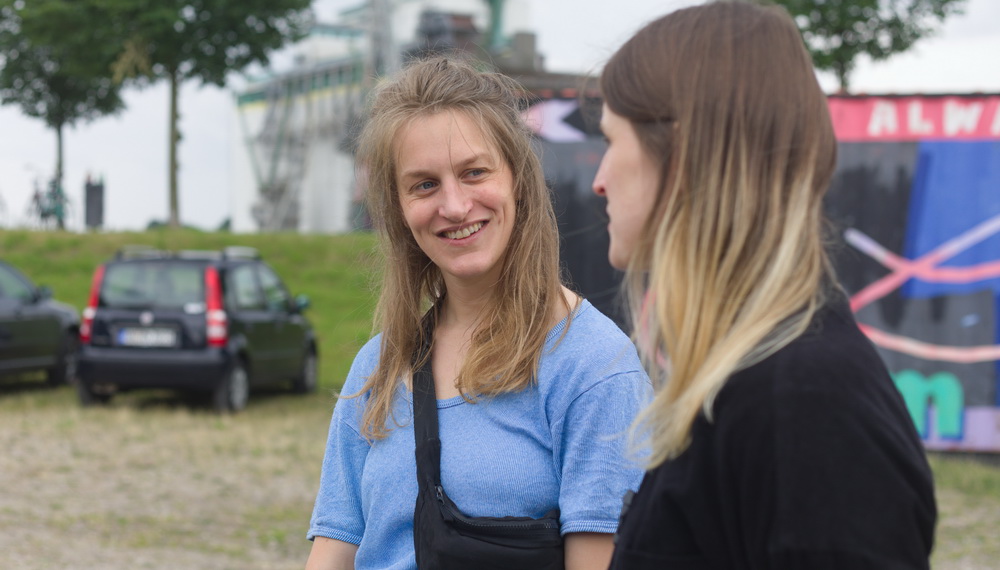
Punk music is more relevant today than ever as a reaction to the time we live in, and that’s what Kochkraft’s music is about. It has a raw power to it that works well with the topics of the modern age.
If you look at the last wave of electropunk bands many of those left their electronic sound and turned into the direction of ‘normal’ punk music or rock music. Have you thought anything about your future direction, music-wise?
Of course, we’re gonna stick to electropunk. We just love techno so much and what we do reflects that. It’s the vibe of techno combined with the attitude of punk. Again, we never tried to write electropunk music, it’s our love for punk music and techno and apparently, it becomes electropunk when you combine those two. We’re just a band that happen to have a lot of electronic gear – love our Moog – which we combine with other instruments. And we’re not a pure punk band either, which is necessary to say, but we have the energy of a punk band on stage.
The image of punks, you know drunk people playing small clubs or being loud on the streets, is not really us, we don’t fit into that image. We’re about the political side of punk, not the other things associated with the scene.
And that may also be the reason you’ll get booked for different types of festivals as well, like Rock ‘n’ Roll Butterfahrt, which is a punkrock festival, and today’s Habitat Festival which mostly has techno acts on their line-up.
Yes, isn’t that just great? (laugh) But it’s not that different, it is the same attitude and vibe, just slightly different music. I [Nicki] don’t think it would be a great idea to book us for a reggae festival though because we don’t share that type of energy, but Habitat is right up our alley. It doesn’t matter if it’s electronic or played on guitar, it’s the same vibe. A few weeks ago we played at Fusion Festival [electronic music festival in north-east Germany] and that works well because of its connection to the political aspect behind the festival that taps into what we do. It’s the same with other techno festivals like Love Parade. We would be a perfect match there – books us, please. (laugh)
The different techno and punk scenes have so much in common, especially the political aspects of the scene and the music. Maybe it’s a sort of punk ethic we’re tapping into, not necessarily punk music.
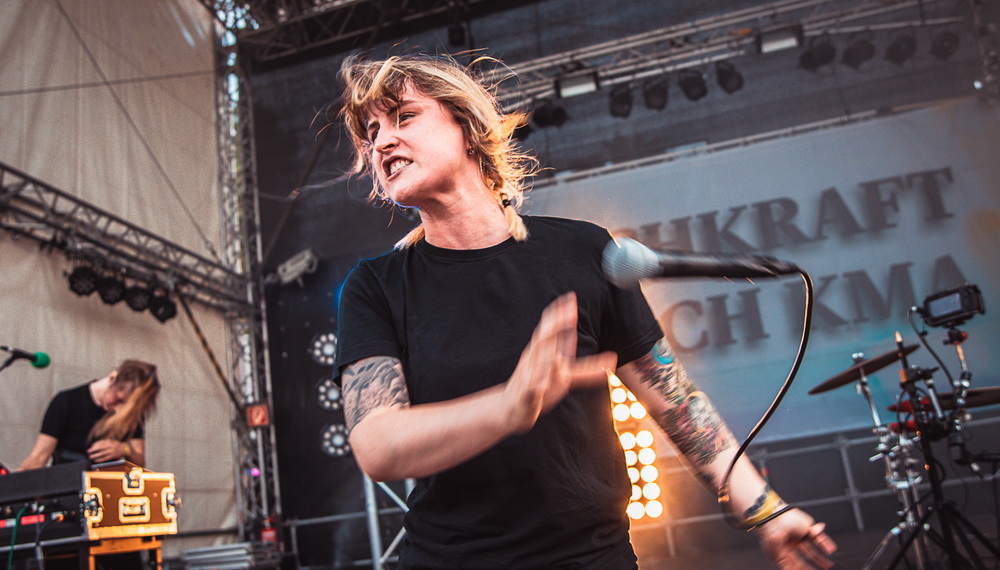
People understand what we’re about if they watch us live. You may not get the full picture of what we are if you just listen to us on Spotify. A few weeks ago we played at a festival in Chemnitz and it wasn’t many people at the show, and they didn’t know anything about us, but at those small shows, in an intimate setting, we get a chance to talk to people which is great for us as well. You can’t be that personal with the audience at big festivals like Deichbrand because you will have security all over you, stopping you from causing too much riot. (laugh)
You have been touring the album quite much last year and still continue doing it. Does it feel like this is the year when you start to take off and that people and bookers request more shows?
Yes, but we need to play gigs to get more gigs. If we do one show, bookers or venues watch us and book us for two more – that’s how it works for us. It’s kind of an exponential effect for us. (laugh) But you need to watch us live, that’s where we thrive and why people want us to come back. This year has been amazing so far, not only because we’ve done a lot of shows already but also because we got the chance to play bigger festivals with bigger audiences which leads to even more gig requests. Let’s see what happens after the summer but we’re quite sure we’ll have more gigs coming up.
Yeah, and as you said, punk is needed more than ever.
Yeah, but not without embracing your inner child. (laugh)
*****
Interview photos: Sophie Dobschall
Live photos: Christian Berg
*****
Kochkraft durch KMA pages


Messed!Up recommends
